Honeybee visiting the flower of a southern magnolia in the Arboretum. Magnolias were among the earliest flowering plants to evolve, and they use flower scent to attract insect pollinators. (Photo: Niall Dunne)
BY JASON MORSE
In the ever-changing interplay between plants and their environments, adaptation is key to survival. From towering trees to tiny ferns, plants have evolved an astonishing range of strategies to thrive in diverse habitats. Whether it’s the crown architecture of trees shaped by climate patterns or the clever floral mechanisms that attract pollinators, each plant’s unique features are a testament to the forces of natural selection.
We can learn a lot about the natural history of plants by exploring some of their most fascinating adaptations—from how leaf size and shape reflect their environment to the surprising ways seeds spread across the globe. By understanding these adaptations, we gain a deeper appreciation for the resilience and ingenuity of the plant world.
Crowning Achievements
A tree’s crown—the upper canopy that gives a species its distinctive silhouette—is one of the clearest indicators of how and where a plant has adapted to its native environment. Crown shape varies dramatically between species, evolving in response to light, water, competition, wind, and browsing by animals. From the towering, pyramidal form of a coast redwood to the broad, flat-topped canopy of an African acacia, each crown tells an ecological story. In the Arboretum, where ecosystems from around the globe unfold in a short walk, these differences are easy to observe—even from 50 feet away.

Tall, native conifers along Azalea Way display conical-shaped crowns, an indicator that they likely evolved in a wet climate. (Photo by Niall Dunne)
The two biggest drivers of crown form are precipitation and competition. Trees in wet habitats often grow tall with narrow crowns to compete for light, while those in arid zones grow shorter and broader to conserve water. In dry climates, less competition also allows crowns to spread without interference. Snowfall adds another layer of influence, often favoring narrow, conical crowns that shed heavy snow more effectively than rounded ones.
Disturbance shapes crowns, too. High winds—common in alpine zones—favor low, wide growth, even in wet areas. Fire can alter crown form by removing lower branches, encouraging rounded growth in species like ponderosa pine. Browsing animals also leave their mark: Acacia trees reflect the reach of giraffes, while the lofty, rounded crown of the mature monkey puzzle hints at ancient herbivores like the brontosaurus. In every shape, there’s a record of survival, strategy, and deep ecological memory.
Form and Function: Leaf Size
Leaf morphology, or shape, showcases some of the most dramatic adaptations in the plant world. From the 60-foot fronds of Raphia regalis, a palm tree in Borneo, to the nearly microscopic leaves of duckweed (Lemna species), leaf size spans an astonishing range. Generally, leaves grow larger in shady, moist environments and stay small in sunny, dry ones. Large leaves allow plants to maximize their ability to photosynthesize (make food from the sun’s rays) in environments with limited light, such as under a dense forest canopy. In consistently wet understories, such as those of tropical rainforests, the bigger the leaf, the better—in order to beat off competition from other plants.

The foliage a bigleaf magnolia, Magnolia macrophylla, in Arboretum’s old nursery area. Large leaves are associated with wet, shady environments. (Photo by Niall Dunne)
In sunny, dry environments, leaves tend to be smaller in order to reduce surface area and associated water loss from leaves. Moisture evaporating from the stomata, or tiny pores, of leaves is an essential mechanism for plants to move water and dissolved nutrients from the soil through their roots and up into their crowns—however, too much water loss can be fatal.
Of course, there are exceptions to this general, bigger-wetter-smaller-drier rule, such as with floating aquatic plants like duckweed, whose tiny leaves help it drift to new waters during floods. While you won’t find a raffia palm in the Arboretum, the bigleaf magno- lia (Magnolia macrophylla)—native to the wet, forest understory of the U.S. Southeast— impresses with leaves up to three feet long. In contrast, invasive duckweed (Lemna minuta) dots our ponds in dense, green mats this time of year, causing challenges for aquatic life.
Form and Function: Leaf Shape and Thickness
Plants also refine their leaf shapes to suit environmental conditions. Two common features—serrated margins and compound leaves—may boost photosynthesis in cool, shady areas. Both features increase leaf edge surface and hence the number of leaf stomata, which not only allow more water vapor and oxygen to exit but also more carbon dioxide to enter the plant. This can increase the rate of photosynthesis, a win in cool, moist environments where water loss is less risky.

Vine hill manzanita, Arctostaphylos densiflora ‘Howard McMinn’, in the Witt Winter Garden in spring. Small leaves often indicate adaptation to dry, sunny habitats. (Photo by Niall Dunne)
Along the same lines, lobed leaves—such as those found on many oaks and maples—are linked to keeping plants cool in sunny, exposed habitats. Essentially, deep lobes increase a leaf’s edge surface relative to its total area, making it function like a grouping of small leaves. The lobing also may create small-scale air currents around the leaf, helping with heat dissipation. Deeply divided leaves may indicate adaptation to windy environments, particularly in tropical regions prone to cyclones. Palm trees, such as the Chusan palms in the Visitors Center parking lot, are a prime example. Their flexible, lightweight, feather- or fan-shaped leaves allow driving wind and rain to pass through, helping prevent the trees from being uprooted.
Leaf thickness also matters. Plants from arid habitats tend to have thicker, waxier leaves to reduce moisture loss—think succulents. Tiny hairs, or trichomes, on leaves and stems can also reduce water loss, deter insects, block wind, and protect against UV rays. Leaves from wet environments are often angled downward and have pointed tips—adaptations that help the plants shed water and prevent fungal infections.
Even leaf color has ecological significance. Red pigments—like those found in the new growth of Vaccinium ovatum or the bright red fall color of a Japanese maple—may protect vulnerable tissues from sunburn or insect damage. One intriguing theory even suggests that autumn color helps fool aphids, which are drawn only to green foliage, during a time when the trees are engaged in the important work of storing energy for the winter.

A full moon maple, Acer japonicum, in the Woodland Garden. Serrated leaves may help enhance photosynthesis in cool, shady areas. (Photo by Jason Morse)
Ancient Survivors: Ferns, Mosses, Horsetails
This is where plant evolution gets particularly fascinating. The earliest land plants—mosses, ferns and horsetails—evolved during a time when Earth was far warmer and wetter than it is today. Their reproductive strategy, though primitive by modern standards, was well suited to those humid, steamy conditions.
Unlike conifers and flowering plants, which rely on wind and animals for fertilization, these early plants rely on water. In the “gametophyte” phase of their life cycle, they produce sperm and eggs on the forest floor, and the sperm must actually swim through a film of water to reach the egg. Once fertilized, the resulting “sporophyte” phase of the plant develops and eventually releases gametophyte-producing spores, sending the cycle back to the beginning.
Despite its seeming fragility, this method has worked for hundreds of millions of years. The mosses carpeting tree trunks, the lush ferns in the Woodland Garden, and the persistent horsetail (often named the Arboretum’s most stubborn weed) all bear witness to the durability of this ancient design. These plants have survived dramatic shifts in climate and the rise of powerful competitors: the woody, seed-bearing gymnosperms and the flower-producing angiosperms.

A royal fern, Osmundia regalis, by the lower Woodland Garden pond. It produces reproductive spores in brown, tassel-like clusters at the tips of fertile leaves. (Photo by Jason Morse)
Conifers and Cones
A major leap in plant evolution came about 350 million years ago, with the rise of gymnosperms— currently more than 1,000 species strong and largely made up of conifers. These towering trees supplanted ancient, 100-foot-tall club mosses by developing a remarkable innovation: wood. Their tall, straight trunks evolved as a rapid-growth strategy to outcompete neighbors for sunlight.
Gymnosperms also revolutionized reproduction. No longer reliant on water for sperm delivery, they encased it in pollen grains, which (in the case of conifers) travel mostly by wind, though occasionally with help from insects. They evolved soft pollen cones on their branches to produce and release the pollen, as well as wood-producing seed cones containing ovules to receive pollen. Fertilized eggs developed into seeds, encased inside a protective woody cone. Not just genetic packets like spores, these seeds are nutrient-rich capsules that nourish seedlings in their earliest days.
Gymnosperm seeds also evolved dispersal strategies, such as the wings found on pine seeds that help them catch the wind and travel away from the mother tree. Some species, such as the yews (Taxus species), even developed fleshy, berry-like scales or arils around their seeds to attract dispersal by birds and rodents. (Note: Gymnosperm means “naked seeds” in Greek, and their seeds differ from those of angiosperms, in that they are not enclosed by an ovary or fruit.) While still primitive compared to flowering plants, these reproductive and dispersal strategies laid the groundwork for more sophisticated methods to come.

Developing seed cone of a Taiwan spruce, Picea morrisonicola (in the Sorbus Collection area), with smaller, softer pollen cones underneath. (Photo by Niall Dunne)
The Flowering Revolution
Roughly 130 million years ago, flowering plants—angiosperms, meaning “container seeds” in Greek—emerged and quickly reshaped the plant kingdom. Among the first were magnolias, which set the template for reproduction that the now more than 300 thousand flowering species are following. Like with the gymnosperms, their sperm traveled inside pollen grains, but were now carried from the male part (stamen) to the female part (pistil) of a flower, often across great distances.
To enable this journey, plants evolved a dazzling variety of pollen delivery systems— many of which can be seen throughout the Arboretum. Only 10 to 20 percent of flowering plants are wind pollinated, while the rest require the aid of a pollinating animal. Most pollen grains are sticky, clinging easily to the legs and bodies of insects, birds, or bats. However, attracting these pollinators takes work. A flower must be seen and landed on for pollen to successfully reach another flower’s pistil, where it’s drawn down a stalk-like style to the ovary, beginning the creation of a seed.
Visual appeal is the first line of attraction. While some plants (like the wind-pollinated oaks and grasses) hide their blooms in plain sight, others spare no effort in producing vivid, intricate displays. From the hot pink of fuchsias to the cool blue of Himalayan poppies, the floral color palette is as diverse as the pollinators they aim to seduce. Producing petals and pigments is metabolically expensive, but clearly worthwhile—the global success of flowering plants proves it.
Shape matters, too. Most flowers are radially symmetrical, with pollen-exchange organs centered like a bulls-eye. This radial pattern appeals to pollinators and perhaps to humans as well. Whether this design is inadvertently attractive to us, or the result of co-evolution, remains a mystery—but our love of flowers may not be so different from that of the bees.

Western skunk cabbage, Lysichiton americanus, blooming along the Woodland Garden stream in March. The flowers emit a foul odor that attracts scavenging flies and beetles. (Photo by Niall Dunne)
Floral Scent and Sugar: Luring Pollinators
If the flower is a billboard, then nectar is the irresistible offer. This sugary reward draws a wide array of pollinators—bees, butterflies, moths, hummingbirds, bats, and even mosqui- toes and wasps. While bees famously convert nectar into honey, most pollinators simply consume it for a quick burst of energy.
Scent is another powerful lure. Many flowers release complex blends of volatile organic compounds tailored to attract specific pollinators. To human noses, these often register as sweet, spicy or musky—key elements in why we find flowers so appealing, whether in a garden bed or a vase. Remarkably, even in the absence of visible flowers, these fragrant compounds can boost human mood and well-being.
But not all floral fragrances are pleasant—at least not to us. Some plants cater to pollinators with less refined tastes. Skunk cabbage, corpse flower, English laurel and Callery pear produce scents that mimic rotting flesh or dung. To flies searching for a place to lay eggs, these pungent odors are pure perfection.

The bright-red summer fruits of Pernyi’s holly, Ilex pernyi, in the Holly Collection. The fruits are magnets for birds in the plant’s native homeland of Mongolia.
Fruit: Luring Seed Dispersers
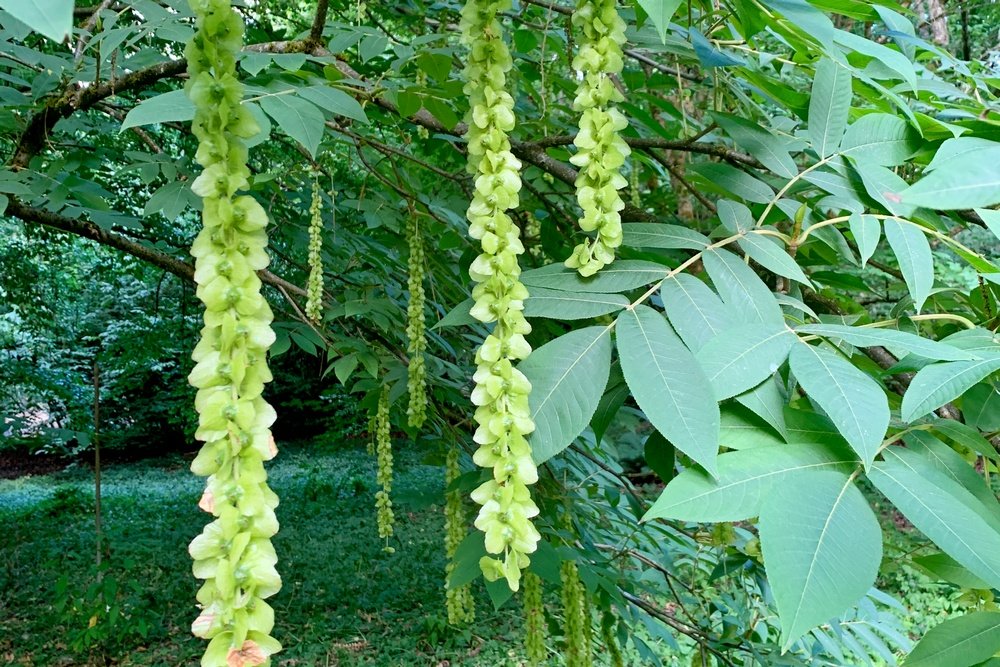
Flowering plants are just as creative in dispersing their seeds as they are in attracting pollinators. Take the coconut palm, for example: Its large, fibrous, buoyant fruits are dropped into the surf and ride ocean currents to tropical beaches worldwide. Wind is another powerful seed trans- porter, with samaras from maple trees spinning through the air, or cottonwood trees releasing a flurry of fluff-coated seeds in early summer.
Then there are plants like cockleburs (Arctium species), which latch onto fur or animal hides with tiny “crochet” hooks. But cockleburs are just one example of how plants rely on the mobility of animals to disperse their seeds. Many plants take a more direct approach by wrapping seeds in a nutrient-rich fruit, hoping an animal will eat it and carry the seeds far from the parent plant. Fleshy fruits like crabapples, mountain ash, and berries rely on this simple strategy: Wrap the seed in tasty pulp, and the seed will likely end up far from home.
Silent Architects of the Natural World
The endless creativity of plant adaptations shows us just how deeply intertwined life is with its environment. From the crown structure of trees to the reproductive strategies of flowers, every plant has developed specific features to navigate the challenges of its habitat. Whether attracting pollinators with colorful blooms, dispersing seeds with the help of animals, or simply surviving in harsh climates, plants continue to captivate us with their ingenuity.
As we observe these adaptations in action—whether in the field, garden, or in the Arboretum—we not only gain insight into the plants themselves but also into the larger ecologi- cal processes that sustain our planet. Plants, in their resilience and diversity, are the silent architects of the natural world, continually adapting and evolving to ensure the continuity of life on Earth.
Jason Morse is a landscape architect and writer, and a member of the “Bulletin” Editorial Board. He is also a former Arboretum Foundation board president and strategic advisor.
Subscribe to Our Bulletin Magazine!
This article is reprinted from the summer 2025 issue of the Arboretum Bulletin, our quarterly botanical and horticultural magazine. Published since 1937, the Bulletin is a benefit of Arboretum Foundation membership and features in-depth articles on the Arboretum collections and history, as well as general information of interest to plant lovers in the Pacific Northwest and beyond. Join/subscribe today.