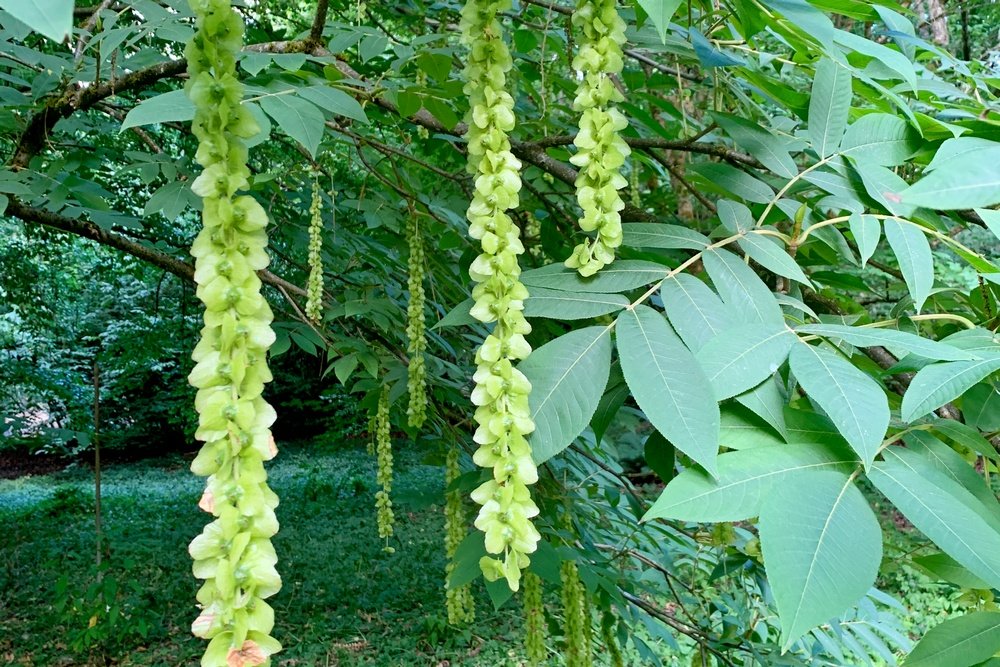
Anna’s hummingbird visiting a native twinberry honeysuckle (Lonicera involucrata) in the Arboretum. (Photo by Larry Hubbell)
Research Confirms That Native Plants Provide Better Wildlife Benefits Than Non-Native Plants
In the Fall 1991 issue of the “Bulletin,” University of Washington biology professor P. Dee Boersma and her then-student Kama Almasi wrote about a research project they had just conducted in the Arboretum, asking the question whether birds can tell the difference between native and non-native conifers in the plant collection. They studied four plots in the park—two with native Douglas fir, western red cedar, and western hemlock, and two with Asian and European cedars and firs, as well as some conifers from California and Oregon. They discovered that more than twice as many native bird species used the native patches compared to the non-native ones.
The authors also discussed the rapid decline of native, undisturbed coniferous vegetation in the Pacific Northwest and urged, “Considering the importance of this vegetation to our native birds, native conifers should be planted where replanting is done; it is important for providing food and refuge for native bird species…When picking plants for the yard, choosing native species may be one way to help native birds survive in their increasingly urbanized and fragmented environment.”
For advocates of wildlife gardening, it has long been considered a given that native plants provide the best resources for native birds, insects and other creatures. After all, these organisms have coexisted, and in many cases co-evolved, for thousands of years. Surprisingly, though, until recently there hasn’t been a lot of scientific research around this idea.

A native mining bee (Andrena species) visiting the flowers of our native ocean spray (Holodiscus discolor) in the Arboretum. (Photo by Niall Dunne)
The Nativity Debate
In 2015, Linda Chalker-Scott, an associate professor of horticulture at Washington State University, published a literature review of the science examining the claim of “superiority of native plants over introduced species, including their ability to enhance ecosystem biodiversity.” She looked at more than 120 studies from 30 different countries and—somewhat shockingly—concluded that parameters such as landscape diversity, structure, and function are more important than plant nativity when it comes to enhancing urban biodiversity.
What does “landscape diversity, structure, and function” mean? Chalker-Scott provided a list of action items to help home gardeners optimize these landscape elements and improve habitat for wildlife:
- Reduce open lawn and replace it with vertically diverse vegetation;
- Increase shrub and tree cover;
- Select both native and non-invasive, intro-duced trees and shrubs to increase plant diversity;
- Plant fruit-bearing trees, shrubs, and ground covers for human and animal consumption alike;
- If feasible, add a permanent water feature.

Soldier beetles on the flowers of a native yarrow, Achillea millefolium, in the Arboretum. (Photo by Niall Dunne)
Superb advice, but is it still up-to-date on the topic of native versus non-native? Not according to three other literature reviews that have been published within the last four years. See Berthon et al. (2021), Tallamy et al. (2021), and Tartaglia and Aronson (2024) in the references list below. The most recent paper, by two Rutgers ecolo-gists, Elena Tartaglia and Myla Aronson, found “overwhelming evidence that native plants support higher faunal abundance and diversity than non-native plants in urban landscapes.”
Of course, trees and shrubs provide other ecosystem services besides enhancing biodiversity, such as removing air pollutants, lowering air temperature, protecting water quality, and carbon sequestration. And in her paper, Chalker-Scott also made the claim that “native species are often poorly suited to urban conditions,” and that many introduced species are better adapted to tackle challenges such as poor soil and air pollution.
If non-native plants deliver better overall ecosystem services in cities, this could tip the balance back in their favor. However, Tartaglia and Aronson found little evidence of this. Out of 165 papers examined, they say, “120 studies found that native plants outperformed non-native plants in supporting biodiversity and ecosystem services, or had higher performance in urban habitats.”
The authors did admit that there is a dearth of studies directly comparing the physiological performance of native and non-native plants in urban areas—and further research is needed. However, Aronson is also the lead author of an influential paper from 2014 that found the majority of naturally occurring plant species in the world’s cities are native to their respective regions, indicating that many native plants can adapt just fine to urban settings.

Bumble bee visiting a native Canada goldenrod, Solidago canadensis, in the Arboretum. (Photo by Niall Dunne)
Supporting the Food Web
I have lots of Pacific Northwest natives growing and doing well in my small, very urban Seattle garden, including Douglas fir, vine maple, red-flowering currant, common snowberry, salal, evergreen huckleberry, goatsbeard, western bleeding heart, and Cascade mahonia. (And when I planted them, I followed the golden rule of sustainable gardening, which is to grow your plants in sites where they are naturally adapted to thrive—shady, moist conditions in the case of my goatsbeard, and so on.) I notice plenty of animal activity on these plants, but I also notice it on some of my non-native plants. Native bumble bees visit my rosemary bushes when they flower, for instance. Anna’s hummingbirds are happy to visit not only the native currant when it flowers in early spring, but also my non-native fuchsias in summer and fall.
Experienced gardeners know that some non-native plants can provide resources for certain wildlife. And indeed, in 15 percent of the studies reviewed by Tartaglia and Aronson, non-natives outperformed natives in this regard. But the bigger message here is the same one advanced by Boersma and Almasi in the “Bulletin” 35 years ago: If your gardening goal is to help out native insects and birds, choosing native plants is the better way to go.
Through his popular science books, Doug Tallamy, a professor of entomology at the University of Delaware, helps gardeners understand the why behind this message. Some native bees are generalist feeders, and they are not particular about where their pollen or nectar comes from—locally native or imported. Likewise, some birds are not that finicky about the provenance of the fruits they consume. However, Tallamy writes in his most recent book, “Nature’s Best Hope: A New Approach to Conservation That Starts in the Yard” (2019), generalist relationships among plants and animals are the exception in nature, rather than the rule.
If you’re familiar at all with Tallamy’s work, you’ll know that he spends a lot of time talking up the vital importance of insect herbivores, especially the caterpillars of butterflies and moths (lepidopterans). Bees are vital, too, for pollination; however, not a lot of things find bees tasty to eat. By contrast, the juicy larvae of lepidopterans are powerhouses of the larger food web. Caterpillars are the mainstay of most bird diets in North America, writes Tallamy, particularly when birds are rearing their young. Furthermore, he explains, 90 percent of insect herbivores are specialist feeders—meaning they need native plants to survive.

Pacific crabapple, Malus fusca—one of our region’s keystone native plants—is a host plant for more than 200 species of native butterflies and moths. (Photo by Niall Dunne)
And, it turns out, it’s not just any native plant they need. Some native species and genera (groups of species) are what Tallamy refers to as “keystone plants,” providing sustenance for most of the lepidopterans that are so important to the larger food web. Working with the National Wildlife Federation, Tallamy has developed keystone plant lists for all the ecological regions of North America (see www.nwf.org/keystoneplants). Topping the list in our region (“Marine West Coast Forests”) is Garry oak (Quercus garryanna), which supports more than 400 species of caterpillar. Also in the top 10, bitter cherry (Prunus emarginata; 340 species) and Pacific crabapple (Malus fusca; 237 species).
It’s a pretty long list that includes plenty of native conifers, such as Douglas fir (a host plant for 122 lepidopterans). It also includes shrubs and perennials that support specialist bees. For instance, western coneflower (Rudbeckia occidentalis) is said to support 29 specialist bee pollinators and four species of caterpillar. In general, Tallamy advises to plant for specialist pollinators and insect herbivores, and the gener-alists will do just fine.
High Stakes
I look around my own yard and see that I need to include more of Tallamy’s native keystone plants in addition to my Douglas fir, vine maple, evergreen huckleberry, Ceanothus and dogwood. Other gardening practices he recommends—in addition to those on Chalker-Scott’s list above—include cutting out insecticides, leaving patches of bare soil for ground-nesting bees, avoiding fall clean-up and pruning to encourage bees that nest in pithy stems, and making sure bees and other pollinators have floral resources through-out the growing season.

Bumblebee visiting the flower of a Puget Sound gumweed, Grindelia integrifolia, in the Arboretum. (Photo by Niall Dunne)
I don’t plan to rip out all the non-natives in my yard—and Tallamy understands this would be an unrealistic ask for most gardeners and plant lovers. But he does encourage folks to tip the scales in favor of natives: “Landscapes with a healthy dose of keystone plant genera almost always have room from some striking non-invasive introduced ornamentals without losing their ecological clout.” The stakes are high: We hear in the news all the time about our wildlife populations declining and collapsing, and Tallamy sees the potential for gardens to redress some of the damage by becoming mini, interconnected “homegrown national parks.”
In their paper, Tartaglia and Aronson conclude with a message about choosing native plants that echoes Boersma and Almasi, “As the world rapidly urbanizes and habitat is lost and degraded at an accelerating rate, it is critical that urban green spaces support ecosystem function and biodiversity as a necessary means of conservation and maintaining human health and well-being.”
Niall Dunne is the editor of the Arboretum Bulletin and the communications manager for the Arboretum Foundation.
References
Aronson, Myla F.J. et al. “A global analysis of the impacts of urbanization on bird and plant diversity reveals key anthopogenic drivers.” “Proceedings of the Royal Society B” 281: 2013-3330.
Berthon, K. et al. “The role of ‘nativeness’ in urban greening to support animal biodiversity.” “Landscape and Urban Planning.” 205:103959. 2021.
Chalker-Scott, Linda. “Non-native, noninvasive woody species can enhance urban landscape biodiversity.” “Arboriculture & Urban Forestry.” 41(4):173 –186. 2015.
Tallamy, Douglas W. “Nature’s Best Hope: A New Approach to Conservation That Starts in Your Yard.” Timber Press. 2019.
Tallamy, Douglas W. et al. “Do non-native plants contribute to insect declines?” “Ecological Entomology” 46: 729–42. 2021.
Tartaglia, Elena S. and Aronson, Myla F.J. “Plant native: comparing biodiversity benefits, ecosystem services provisioning, and plant performance of native and non-native plants in urban horticulture.” “Urban Ecosytems.” 27: 2587–2611. 2024.
Subscribe to Our Bulletin Magazine!
This article is reprinted from the summer 2025 issue of the Arboretum Bulletin, our quarterly botanical and horticultural magazine. Published since 1937, the Bulletin is a benefit of Arboretum Foundation membership and features in-depth articles on the Arboretum collections and history, as well as general information of interest to plant lovers in the Pacific Northwest and beyond. Join/subscribe today.