Children enjoy a “tactile circle” at Lviv University Botanical Garden.
BY TONY ALLISON & EMILEE WEAVER
“Developing a therapeutic horticulture program arose as an inspiration during our trip to Seattle in the fall of 2023, when the war in Ukraine had been going on for a year and a half,” recalls Myroslava Helesh, a senior botanist-educator at Ivan Franko National University Botanical Garden in Lviv, Ukraine. “It soon became crystallized as a response to the challenges brought by the war.”
Therapeutic horticulture (TH) is the professionally facilitated use of plant and nature-based activities to promote health and well-being. In TH programs, participants engage in gardening, plant care and other nature connections as a way to support emotional resilience, physical recovery, cognitive function and social interaction. The practice is rooted in evidence-based outcomes and draws on timeless, deeply instinctive human bonds with nature as a source of healing and renewal. Myroslava and her Ukrainian colleagues quicky grasped the great potential of TH as a mode for healing in war-torn Ukraine, and they believed that their botanical gardens would be ideal places to introduce it.
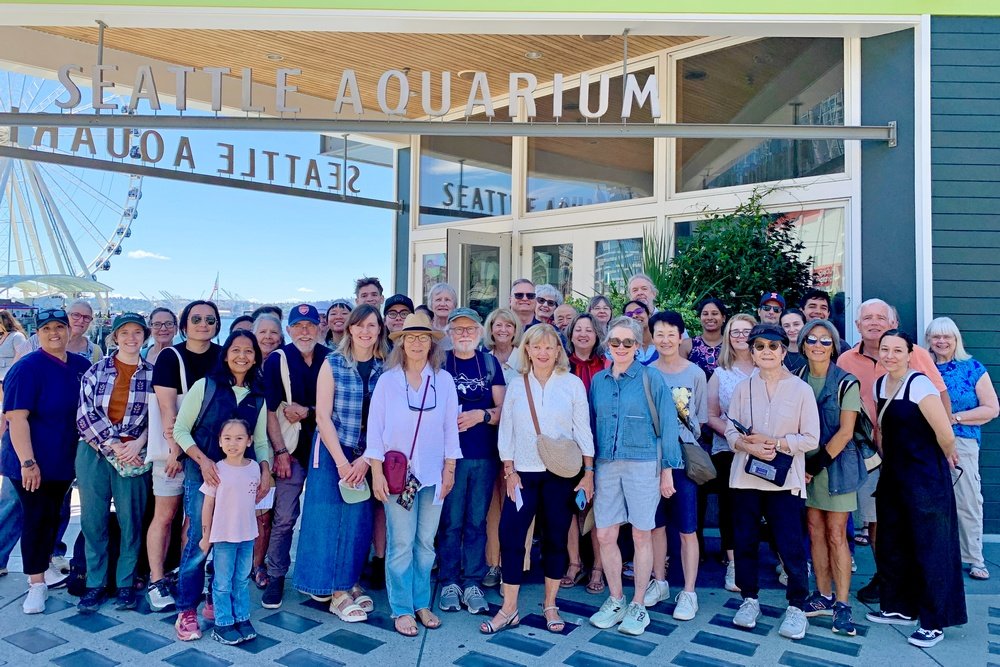
Myroslava’s Seattle visit in 2023—in the company of five other botanical garden educators from Ukraine, Armenia and Georgia—included observing programs and meeting with staff at the Arboretum, Center for Urban Horticulture, and other environmental education institutions in the region. Arboretum Foundation members may recall that the group delivered an online presentation about their countries and gardens that included a powerful portrayal of how botanical gardens in wartime Ukraine had become oases of respite, recovery and learning—a role they continue to play today. (Their visit was described in the Spring 2024 edition of the “Bulletin.”)

A therapeutic horticulture tree tour for veterans at Kyiv Gryshko National Botanical Garden, Ukraine.
Program Development and Success Stories
In early 2024, the sponsor and organizer of the Seattle trip, Partnerships for Nature—a Bainbridge Island nonprofit focused on nature-based collaboration with countries of the former Soviet Union—began introducing TH to staff from Ukraine’s botanical gardens. For professional expertise, Partnerships for Nature turned to North Carolina Botanical Garden (NCBG), a recognized leader in TH training in the United States and around the world.
Emilee Weaver, NCBG’s program manager for TH at the time, enthusiastically joined the initiative. With more than 15 years of experience developing TH programs in diverse settings, Emilee has worked with a wide range of populations. She centers her work at the intersection of TH and mental health, developing programs in inpatient psychiatric hospitals, elder-care communities, botanical gardens, farms and other restorative environments.
Evidence-based studies have long documented the effectiveness of horticultural and other nature-based therapies (see “Resources and References” below). Participants report decreased anxiety and depression, reduced blood pressure and heart rate, and increased social connection and self esteem. Emilee recalls one participant, a veteran, who said that growing vegetables for his community through a TH program gave him “a new mission worth living for.” Another participant, a stroke survivor, found renewed dexterity and confidence through use of adaptive gardening tools and weekly planting sessions.
“The science is important,” Emilee reflects, “but it’s the stories that stay with you.”
As part of the Ukraine collaboration, Emilee and Partnerships for Nature’s Board President and Co-Founder, Tony Allison, led a project that included online training, mentorship, and the translation and adaptation of NCBG’s TH certificate course into Ukrainian. Emilee also coached Ukrainian botanical garden staff as they launched pilot TH programs. In October of 2024, we (Tony and Emilee) traveled to southeastern Poland with another experienced TH practitioner from North Carolina, Amy Stidham, to conduct a three-day, hands-on TH workshop for our Ukrainian partners, who crossed the border into Poland to attend.

A therapeutic horticulture outing in Odesa University Botanical Garden, Ukraine.
By the end of 2024, more than two thousand Ukrainians had participated in TH-related programs in five different botanical gardens across Ukraine, and the numbers continue to grow, both in botanical gardens and elsewhere. Beneficiaries of Ukraine’s emerging TH programs include displaced families, children, veterans, those with physical or mental disabilities, and others subjected to trauma and loss.
“In war, children experience stress and uncertainty about the future,” explains Tetyana Sobko of Kryvyi Rih Botanical Garden of the Ukraine National Academy of Sciences, which is located near the war zone in central Ukraine. “TH activities help to expand the circle of communication, improve mood, and relieve psychological tension.” Programs in the Kryvyi Rih garden have included planting and caring for trees and shrubs, enjoying aromatic and sensory plants, and sharing “botanical tea” sessions designed for relaxation.
At M.M. Gryshko National Botanical Garden in Kyiv—also part of the Ukraine National Academy of Sciences—botanical art therapy and hands-on gardening activities have become popular among both children and adults. So have biodiversity-themed garden walks. Participants have included patients of Ohmatdyt Children’s Hospital, which was struck by a Russian missile in 2024. Alla Gnatiuk, a senior botanist-educator, has even coauthored with her colleagues a richly illustrated, 70-page manual titled “Therapeutic Botany” to help others in Ukraine implement similar programs.
In Lviv, Myroslava, along with other staff members and the garden’s director, Andriy Prokopiv, developed TH activities for children with learning disabilities and designed and installed a “tactile circle” for walking barefoot on a variety of natural surfaces, which has proved extremely popular.

Myroslava Helesh leading a therapeutic horticulture program for children at Lviv University Botanical Garden, Ukraine.
Expanding Education Access
In June 2025, Myroslava, Tetyana, Alla, and seven of their colleagues from five Ukrainian botanical gardens proudly received TH certifi-cates from NCBG. Emilee presided over an emotional online graduation ceremony marking the group’s remarkable achievement. Several of the graduates are now developing their own Ukrainian-language TH course, drawing on their experiences and training. The course is expected to launch in early 2026, with about 20 participants from botanical gardens and other organizations serving vulnerable populations.
Emilee, who now serves as Director of Learning and Community Engagement with Root in Nature—a Canadian organization devoted to expanding international access to online TH education and providing a professional development network for practitioners—continues to collaborate with Tony and the Partnership for Nature team as they help to expand the TH platform and network in Ukraine.
Therapeutic horticulture will no doubt continue to grow in importance in wartime and postwar Ukraine, and elsewhere as well. Partnerships for Nature, with Emilee’s help, has also introduced TH in Armenia—another region affected by conflict—with scholarship support from NCBG and Root in Nature for five current students. Both NCBG and Root in Nature offer online TH certificate courses to participants in the U.S. and around the world, opening doors for anyone wishing to pursue the field of healing through nature.
Therapeutic horticulture is just one branch of a broader, growing movement of nature healing, which includes practices such as forest bathing (shinrin-yoku), therapeutic hiking, and mindfulness in nature. The concept that engagement with nature restores health and balance is ancient, but it has seen a resurgence as people rediscover nature as an antidote to stress and disconnection. Locally, the Arboretum offers forest bathing sessions, while Bellevue Botanical Garden, Bloedel Reserve, and other nearby plant-based institutions provide their own programs focused on mindfulness and stress reduction.
Whether in Ukraine, Armenia, or here in the Seattle area, therapeutic horticulture and other forms of nature healing are catching on and are growing into widespread sources of healing that know no boundaries.
Tony Allison is the co-founder and board president of Partnerships for Nature, and a former educator at Washington Park Arboretum.
Emilee Weaver is the director of learning and community engagement at Root in Nature, a leading resource for thera-peutic horticulture based in Canada.

Lyudmila Boyko, Director of the Kryvyi Rih Botanical Garden, Ukraine, leading a therapeutic horticulture program.
Defining Therapeutic Horticulture
Therapeutic horticulture is often confused with horticultural therapy, a more clinical practice requiring specialized training and professional registration through the American Horticultural Therapy Association. Horticultural therapy involves structured, goal-oriented activities designed to achieve specific therapeutic outcomes within an established treatment or rehabilitation plan. Therapeutic horticulture is a more community-based practice that can be facilitated by non-clinical professionals and volunteers who have received specialized training. It utilizes nature-based activities to support broader goals that address human health and wellbeing in a variety of settings, without the need for clinical oversight.
Therapeutic horticulture differs from forest bathing and other nature-based relaxation or meditation practices primarily in its focus on measurable goals and the use of horticulture-related activities. These activities are often applied flexibly in community settings or incorporated into clinical contexts by professionals cross-trained in therapeutic horticulture.
Designing a Therapeutic Garden
Therapeutic horticulture (TH) gardens vary widely according to the needs and cultures of their target participants. For instance, some TH sites are designed specifically for individu-als living with dementia. The award-winning Maude’s Garden in downtown Seattle includes an ADA-accessible, circular path; birdsong, herbal scents, and textures that “encourage gentle sensory engagement and reminiscence”; lush greenery enclosing the space, lending it “a feeling of safety and protection”; and space for dementia-friendly therapeutic horticulture, nature-based programs, garden care work parties, and tea workshops.
Other therapeutic gardens may focus on sensory and aromatic plants for people with visual impairments or tactile walking areas that provide rich, multi-sensory experiences on natural surfaces. Across all of these settings, certain unifying elements tend to define successful TH sites: easy accessibility, opportunities for participation by those with physical limitations, and an atmosphere of quiet stimulation and respite.
In public gardens, TH spaces are often located away from the main flow of visitors to minimize distractions and create a sense of calm.
You can create a TH garden at your residence, or in a nearby park or school! For guidance, including plant selection, see these recently published books: “Designing, Planting and Using a Therapeutic Garden,” by Sue Jeffries (Crowood Press, 2023) and “RESTORE: How Green Spaces Support Human Restoration,” by Susan Schwarz (Humanaturescapes, 2025).
Jeffries offers highly practical, step-by-step guidance on selecting plants and creating acces-sible therapeutic gardens tailored to the needs of their intended users. It’s an excellent resource for both home gardeners and professional TH practitioners. Schwarz’s book provides a comprehensive overview of how gardens and nature have been used throughout history and across cultures as tools for healing, whether through passive experiences of rest and reflection or active engagement facilitated by professionals. It offers a wealth of insight into the features that make a garden truly therapeutic, and how those principles can be applied in modern settings. ❦

Therapeutic horticulture activities at Odesa Botanical Garden.
RESOURCES
Root in Nature’s website features a free Research and Readings Database containing a comprehensive, organized collection of research studies focused on the benefits, methodologies and applications of horticultural therapy and therapeutic horticulture.
North Carolina Botanical Garden also has extensive TH information on its website.
REFERENCES: HEALTH BENEFITS OF NATURE HEALING
Following is a selection of articles, recommended by Emilee Weaver, about the documented benefits of therapeutic horticulture and other forms of nature healing:
- “Psychological and physical connections with nature improve both human well-being and nature conservation: A systematic review of meta-analyses,” by Barragan-Jason, G. et al. “Biological Conservation.” Volume 277, 109842. 2023. This comprehensive review of 832 individual studies showed that a stronger sense of connection with nature is consis-tently linked to improved mental health, greater happiness, and more frequent pro-environmental actions.
- “Nature-based interventions and mind-body interventions: Saving public health costs whilst increasing life satisfac-tion and happiness,” by Pretty, J. and Barton, J. “Journal of International Journal of Environmental Research and Public Health.” 17(21), 7769. 2020. Examining more than 600 participants, this study assessed woodland therapy, therapeutic horticulture, ecotherapy, and tai chi programs. All interventions improved happiness and life satisfaction while reducing reliance on public health services. The researchers concluded that investing in these low-cost, preventive approaches can enhance public well-being and decrease healthcare expenses.
- “The effect of time outdoors on veterans receiving treatment or PTSD,” by Bettmann, J.E. et al. “Journal of Clinical Psychology.” 77(9):2041–2056. 2021. This study, which involved 49 veterans in trauma-focused therapy, found that spending more time outdoors led to measurable reductions in PTSD symptoms. The researchers concluded that nature exposure can be a valuable complement to traditional PTSD treatments.
- “Nature-based interventions for physical health conditions: A systematic review and meta-analysis,” by Struthers, N. et al. “Environmental Research.” Volume 258, 1 October 2024, 119421. This review of the research showed that nature-based interventions produce measurable physical health benefits, including improved quality of life and significant reduc-tions in blood pressure and body mass index.
Subscribe to Our Bulletin Magazine!
This article is reprinted from the winter 2026 issue of the Arboretum Bulletin, our quarterly botanical and horticultural magazine. Published since 1937, the Bulletin is a benefit of Arboretum Foundation membership and features in-depth articles on the Arboretum collections and history, as well as general information of interest to plant lovers in the Pacific Northwest and beyond. Join/subscribe today.