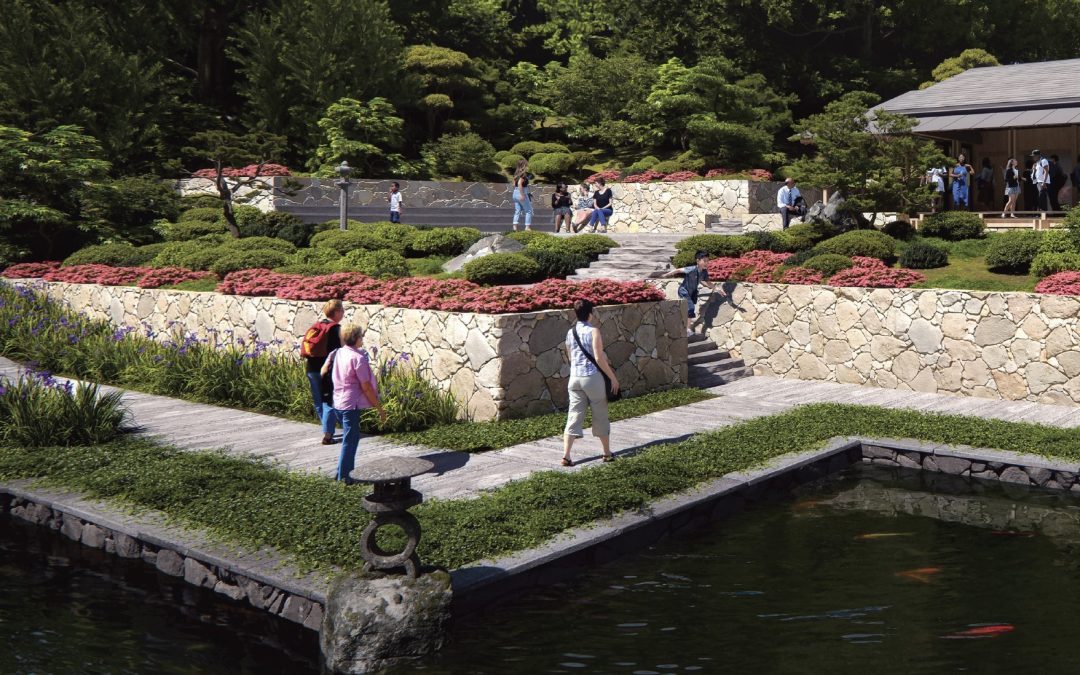
Rendering of the Iskigaki Wall, with the future viewing pavilion (Berger Partnership/Hoshide Wanzer).
After several years of planning and design, two Arboretum Master Plan projects will soon come to fruition: the Japanese Garden Ishigaki Wall, and the Pacific Pathway. Both will improve accessibility for visitors and help us create a more welcoming experience, especially for those with limited mobility.
Ishigaki Wall and Accessible Pathway
Seattle Parks and Recreation is managing the Ishigaki Wall & Accessible Pathway project, in partnership with the Arboretum Foundation. This project will replace a deteriorating basalt retaining wall on the north end of the Seattle Japanese Garden with a drystone masonry rampart. It will also convert the uneven pathway around the north side of the pond into a wheelchair and stroller-friendly path that connects to existing accessible trails and creates an ADA-compliant loop around the Garden, opening it up to all visitors.
The landscape architecture firm Berger Partnership and architecture firm Hoshide Wanzer were hired to create the project designs. Construction is scheduled to break ground in June and run through November 2026. The Garden will be closed from June 22 to July 26, 2026, for the removal of the basalt wall. Visit the Japanese Garden website for regular project updates.
Hand-Crafted Masonry
The ishigaki rampart (ishigaki translates to “stone wall”) will be created by Sakamoto-based stonemason Suminori Awata—one of the last remaining stonemasons of a15-generation lineage—with support from U.S.-based artisans.
Ishigaki walls are magnificent structures that often stand for centuries. They are formed using enormous granite boulders, which are split and shaped by hand into foundational cornerstones. Smaller stones top the cornerstones, with ballast stones filling the gaps instead of mortar.
Awata will direct the precise placement of each stone at the Japanese Garden, explaining that he “listens to the stones and puts them where they want to go.” Once the old wall is removed this summer, Garden visitors will be able to witness this unique process as the new wall takes shape.
The ishigaki wall will be much better aligned with the historic material palette (primarily granite) of the larger Garden. It will also lay the foundation for a longer-term project to construct a viewing pavilion on the north end the Garden, fulfilling the original 1959 plans of designer Juki Iida.

Design rendering of the Pacific Pathway (courtesy Berger Partnership).
Pacific Pathway
Historic, Olmsted-designed Azalea Way forms the backbone of the Arboretum, and at its south end is a steep ridge with another iconic, Olmsted-era feature—the Lookout Gazebo—perched on top. Further south along the ridge is the Pacific Connections Garden, a relatively new exhibit that celebrates temperate forest ecosystems in the Pacific Rim.
Currently, there is no pathway directly connecting south Azalea Way, and its adjacent parking lot, with the gazebo and Pacific Connections. This creates a circulation challenge and a safety problem. The solution is the Pacific Pathway, a new ADA-accessible switchback trail that will safely guide visitors up the steep slope from Azalea Way to the gazebo and plant collections beyond.
Anticipating the China Forest
The new trail will set the stage for the next phase of Pacific Connections: the China Forest. It will wind through the future China Forest’s landscaped garden scenes and feature rare and endangered plants from Mount Emei, a UNESCO World Heritage Site and biodiversity hotspot in China’s Sichuan Province.
Seattle Parks and Recreation is also managing the Pacific Pathway Project, in partnership with UW Botanic Gardens and the Arboretum Foundation. Berger Partnership, who designed the New Zealand Forest at Pacific Connections, has created the design for the pathway as well. Construction is scheduled to run from January to August 2027.
For more information on the projects, visit our website at arboretumfoundation.org/our-work/revitalizing-the-arboretum.

The new trail will improve Arboretum access for all visitors.
Project Support
The Arboretum partners are thankful for the generosity of individual donors and institutional partners, including the Aldarra Foundation and the Washington State Legislature, for supporting these two transformative projects. A recent gift from The Norcliffe Foundation, a private family foundation in Washington State, brought us closer to achieving our fundraising goal for both.
We are still working to ensure these projects are fully funded. If you’re interested in making a donation, please visit our website at arboretumfoundation.org/give and use the “Comments” section of the donation form to designate your gift. For more information about the projects, please email our Development Director Anna O’Donnell at aodonnell@arboretumfoundation.org.
Garden Construction, Impacts, and Closure
The Ishigaki Wall project will cause some disruption to visitor enjoyment of the Japanese Garden this year, and we apologize in advance. The Garden will be closed to the public from June 22 to July 26, when work crews will be dismantling and removing the old basalt wall. The construction of the new Ishigaki wall will also create noise that will interfere with normal visitor enjoyment of the Garden’s serenity. See the Japanese Garden website, seattlejapanesegarden.org, for regular project news and updates.
Niall Dunne, Rumi Tsuchihashi, and Molly Dalessandro from the Arboretum Foundation all contributed to this article.